

Mahjong Crush: Tile Match
reupload
I spent my first sessions with Mahjong Crush: Tile Match expecting a familiar casual puzzle, and that is exactly what it delivers: a quiet board, recognizable tile suits, and a simple goal of removing matching pieces. The appeal is immediate because there is almost no learning curve. You slide tiles into place, look for suitable matches, and try to clear the board before the layout becomes difficult to read.
That simplicity is also the central question for this game: does it remain enjoyable after the first few sessions, or does it become another icon I stop opening? My experience is mixed in a useful way. It works very well as a short, low-pressure distraction, especially when I have only a few minutes. However, players who need deep progression, a strong story, competitive features, or a steady stream of new mechanics may find its basic format limiting over time.
How the first week feels
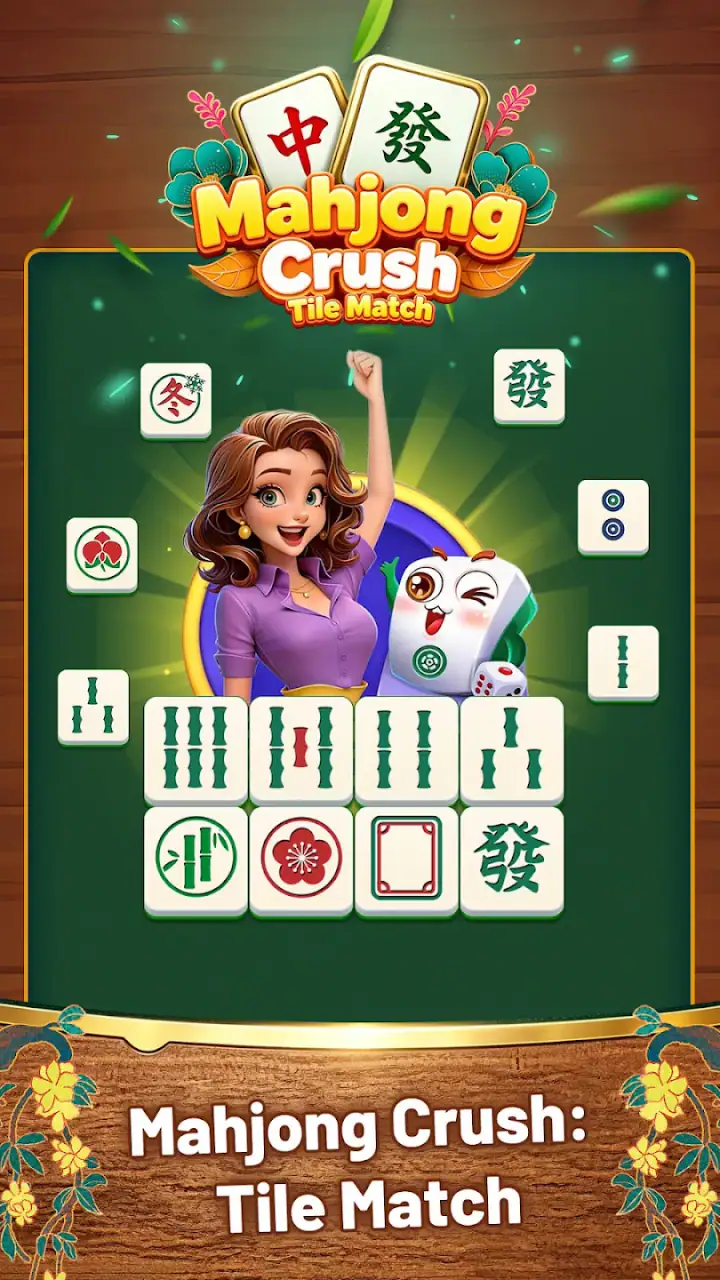
The opening appeal comes from the way the game turns a familiar Mahjong-style matching idea into a compact casual routine. I do not need to remember complicated rules before starting. The visual task is direct: identify matching suits, slide tiles, and make enough sensible choices to keep the board moving. That makes it approachable for someone who wants a puzzle rather than a full game commitment.
I particularly like the low mental barrier when I am waiting for an appointment or taking a short break from work. A round can be treated as a small concentration exercise instead of an event that demands a long uninterrupted session. The game is also easy to explain to another person, which matters if I am recommending it to a friend who does not usually play mobile games.
The first-week rhythm is built around recognition and restraint. Matching the first obvious pair is not always the best move if it leaves awkward tiles behind, so even the simple controls create a modest planning layer. I found myself checking the board before sliding anything, looking for pairs that would open useful space rather than merely choosing the most visible match. That small habit gives the basic interaction more substance than the short store summary suggests.
Related News






A practical tip is to scan the board in groups instead of searching randomly. I look at one area, note the suits that appear more than once, and then compare those possibilities with the open spaces around them. This reduces the feeling of hunting through the entire screen and makes mistakes less likely. It is a minor technique, but it helps the game feel calmer and more deliberate.
The game is free, which lowers the risk of trying it as a casual pastime. Its mature age classification is worth noticing before installation, particularly for families deciding what belongs on a shared device. That rating should not be ignored simply because the gameplay looks gentle or puzzle-focused.
The developer is listed as reupload, and the current release is version 1.0.2. On my device, the important practical detail is that it targets phones and tablets running Android 6.0 or later. That gives it a broad compatibility range for older Android hardware, although the experience will still depend on screen size, touch responsiveness, and how comfortably the tiles fit on the display.
Gallery
Where the early enjoyment comes from
The strongest first-week quality is accessibility. I can begin playing without studying a tutorial, and the matching objective remains understandable even when I return after a day away. That makes it a good fit for people who prefer games that respect their attention rather than constantly introducing menus, currencies, or complicated objectives.
It also suits different moods. When I want to focus, I can treat each arrangement as a small visual puzzle. When I am tired, I can play more slowly and use the familiar suit patterns as a gentle way to stay occupied. This flexibility is more valuable than it sounds because many casual games are either too passive to hold attention or too demanding for a short break.
There is a useful distinction between relaxing and effortless. Mahjong Crush: Tile Match is relaxing when I accept that the board may require thought, but it is not necessarily effortless. If I rush, I can create a less convenient position for myself. That makes the game more satisfying than a purely automatic matching activity, while still keeping the overall mood light.
For a realistic everyday scenario, I would use it during a ten-minute commute when I am seated and do not want to begin a larger game. I can open it, work through a few decisions, and put the phone away without needing to remember a plot or manage a long-term build. It is also suitable for a short evening wind-down, provided I am comfortable with the mature age classification and the game’s particular presentation.
What remains after the novelty fades
The first month is where the game has to justify keeping its place on my device. The core matching loop is pleasant, but its lasting value depends on whether I enjoy repeating the same kind of visual decision. I do not see it as a game that needs to dominate my free time. Its better role is a dependable small activity that I can return to when I want something focused and uncomplicated.
That makes the game strongest for players who enjoy routine. If you like sorting, spotting patterns, and improving your choices through repetition, the basic format can remain satisfying. You may begin to recognize safer moves, notice how a careless slide can affect the rest of the board, and develop a more efficient scanning order. Those improvements are personal rather than dramatic, but they provide a reason to come back.
My preferred way to maintain interest is to give each session a narrow purpose. Instead of playing until the experience feels dull, I might focus on making cleaner opening decisions, avoiding impulsive matches, or finishing a board without repeatedly scanning the same area. This turns repetition into practice. It does not create new content, but it gives the familiar interaction a small sense of progress.
Another useful habit is to stop while the game still feels pleasant. Casual puzzle games often become tiring when I continue automatically after my attention has already dropped. With this title, short sessions protect the part that works best: the quick mental reset. Playing it in small portions makes it more likely that I will want to return later rather than associate it with visual fatigue.
Who is likely to keep using it?
I would recommend it to someone who wants a casual tile-matching game with a clear objective and little setup. It is a sensible choice for players who enjoy Mahjong-inspired patterns but do not want a traditional, rule-heavy tabletop experience. It can also suit people who prefer solo mobile games that do not require coordination with friends or a fixed schedule.
It is less convincing for anyone looking for a deep campaign. Players who measure long-term value through characters, story chapters, elaborate upgrades, multiplayer competition, or constantly changing challenges may quickly feel that the central loop is too narrow. In that situation, a broader puzzle game with several modes would probably earn more lasting attention.
The absence of complexity can be a benefit for older phones and for players who dislike crowded interfaces, but it also means the game has less room to surprise me. A person trying it for the first time may enjoy the clean premise immediately, then ask what new reason exists to return next week. My honest answer is that the reason has to come from enjoying the activity itself, not from expecting a large progression system to carry it.
The rating of 4.8 from around thirteen thousand ratings suggests that many players respond positively to the experience, while the roughly two hundred sixty-five written reviews offer additional public feedback to consider. I treat that reception as encouraging rather than conclusive. A high average can confirm that the basic idea works for a substantial audience, but it cannot decide whether the pace and repetition match my own preferences.
The game has passed one hundred thousand installs, which gives it a meaningful player footprint for a small casual release. I still judge it by the quality of my own sessions. Popularity makes it easier to justify a trial, but it does not turn a simple matching loop into a deep long-term hobby by itself.
Maintenance, friction, and daily use
One advantage of a straightforward puzzle is that it asks little from me between sessions. I do not need to maintain a build, remember a complex objective, or follow a daily schedule to understand what I am doing. That low maintenance is a genuine strength for people who want a game that can be ignored for several days without creating a sense of falling behind.
Returning after a break is painless. I can pick up the basic idea immediately, which is exactly what I want from an occasional phone game. This is different from many live-service alternatives that make a missed week feel like lost progress. Mahjong Crush: Tile Match works better as an on-demand pastime than as a demanding habit.
There is, however, a trade-off. A game that requires little maintenance also gives me fewer reasons to check in. The same freedom that makes it comfortable can make it easy to forget. If the board layouts or goals do not provide enough personal variation, the application may gradually become something I open only when I remember it exists.
My advice is to keep it alongside apps that serve different moods, rather than expecting it to be the only game on the phone. It fills the short-focus slot well. It is not the best replacement for a story game during a long trip, a competitive title when I want social pressure, or a more elaborate puzzle collection when I need variety.
Screen comfort is another practical consideration. Matching games rely on careful visual separation, so a crowded display, glare, or a small phone can make the experience more tiring than it appears in a store preview. I get better results when I hold the phone steadily, use a comfortable brightness level, and avoid playing when I am already struggling to distinguish tile details. That is not a special feature; it is simply the difference between a relaxing puzzle and an irritating one.
Where fatigue begins
The main source of fatigue is repetition. Once the initial pleasure of learning the interaction disappears, I am left with the quality of the board decisions and my own willingness to keep scanning. For some players, that is enough. For me, it means the game works best in controlled doses rather than as a long continuous session.
Visual searching can also become tiring when I approach the board without a method. I used to move my eyes back and forth, repeatedly checking the same tiles. A better approach is to identify a small set of candidate pairs, compare their surrounding space, and commit only after considering what the move exposes. This does not remove the repetition, but it makes the puzzle feel more intentional and reduces wasted attention.
Another limitation is emotional scale. The game can give me the quiet satisfaction of clearing a difficult arrangement, but it does not necessarily create the excitement of a dramatic comeback, a competitive win, or a story reveal. If I am in the mood for strong rewards and visible milestones, this restrained format may feel flat.
That limitation is especially important for people who use games to stay motivated. A player who needs frequent unlocks, changing objectives, or social recognition should probably choose a different casual title. Mahjong Crush: Tile Match is better for self-contained concentration than for external motivation.
I also would not choose it as a family default without checking the mature rating first. The simple tile concept might look suitable for everyone at a glance, but the stated age classification makes that assumption unsafe. Parents should make the installation decision based on the rating, not merely on the fact that the game is a casual puzzle.
How it compares with familiar alternatives
Compared with traditional Mahjong games, this title is easier to approach because I can concentrate on matching and clearing rather than learning a full tabletop rule set. That makes it more welcoming for a quick session. The compromise is that players seeking authentic Mahjong strategy may find the simplified format too light.
Compared with match-three games, it feels less frantic. There is no need to chase a rapidly changing chain of combinations in the same way, so I can inspect the board and make a considered move. On the other hand, match-three alternatives usually provide a stronger sense of spectacle and variety, which may keep some players engaged for longer.
Compared with solitaire-style puzzle apps, the tile focus gives this game a distinctive visual identity, but the long-term question is similar: can the basic arrangement remain interesting after the first novelty? Someone who likes calm repetition may prefer this over card layouts. Someone who wants a wider set of rules may be happier with a collection that offers several puzzle types in one application.
The most important comparison is not which game has more features, but which kind of attention I want to spend. This one rewards patient observation in short bursts. It is a poor fit when I want a social challenge, an unfolding narrative, or a large sense of progression. Knowing that before installing it prevents disappointment.
Is it worth leaving installed?
For me, the answer is yes, but with modest expectations. The free price and low learning barrier make it easy to keep as a backup game for waiting rooms, quiet breaks, and brief evening sessions. I do not need to organize my schedule around it, and I appreciate that returning after time away does not feel like work.
I would remove it if I noticed that I was opening it automatically without enjoying the decisions. That is the clearest sign that the routine has outlasted the value. The game should remain a choice, not an obligation. Its strength is precisely that it does not demand daily attention, so there is no reason to force a habit that has become stale.
The release date is May 26, 2026, and the version I reviewed is 1.0.2. That places the experience in an early stage, so I would pay attention to future updates before making a long-term judgment about how well the game is maintained. For now, I can evaluate the compact matching loop on its own terms, while recognizing that lasting value may depend on how the developer supports it over time.
My final view is that Mahjong Crush: Tile Match earns space as a small, low-maintenance puzzle rather than as a complete all-purpose game. I recommend it to friends who enjoy matching suits, quiet concentration, and short repeatable sessions. I would steer away from it if they need rich progression or constant novelty. After the first-week appeal fades, the game survives only when its simple act of finding the right match is itself enough—and for the right player, that modest pleasure can be surprisingly durable.
FAQs for Mahjong Crush: Tile Match
What is Mahjong Crush: Tile Match?
Mahjong Crush: Tile Match is a casual puzzle game built around the classic mahjong solitaire concept. You clear the board by matching identical, available tiles in pairs. The game is designed for short sessions, with progressively more challenging layouts, colorful tile designs, and a relaxed matching experience that can be enjoyed by both beginners and experienced puzzle players.
How do you play Mahjong Crush: Tile Match?
To play, select two identical tiles that are free to be matched. A tile is generally considered available when it is not covered by another tile and has an open side, allowing it to be selected. Continue removing matching pairs until the board is cleared. Planning your moves is important because choosing the wrong pair can block useful tiles and make the level more difficult to complete.
Is Mahjong Crush: Tile Match free to download and play?
Mahjong Crush: Tile Match can generally be downloaded and played without an upfront purchase, making it accessible to casual players who want a quick puzzle game. However, free-to-play games may include advertisements, optional purchases, or other in-game features that can affect the experience. It is recommended to check the store listing on your Android or iOS device for the latest pricing and purchase details.
Does Mahjong Crush: Tile Match require an internet connection?
The basic tile-matching gameplay may be available offline, which is useful when traveling or when you have limited connectivity. Nevertheless, an internet connection can be required for advertisements, rewards, cloud-related features, updates, or synchronization. Availability may also depend on the version installed and the device platform, so testing the game in airplane mode is the best way to confirm its offline functionality.
Is Mahjong Crush: Tile Match suitable for children and beginners?
The game is easy to understand and does not require previous mahjong experience, so beginners can usually start playing immediately. Its visual matching mechanics are also suitable for many younger players, although parents should review the app’s age rating, advertising, and optional purchase settings before installation. Difficulty can increase over time, making it appropriate for players who enjoy gradually more demanding puzzles.
Pros
- Simple matching rules make it easy for new players to start.
- Short levels are convenient for quick breaks or casual play.
- Tile designs are generally clear and easy to distinguish.
- Progressive challenges help keep the gameplay from feeling repetitive.
- Suitable for players who enjoy relaxing
- low-pressure puzzle sessions.
Cons
- Some levels may rely heavily on luck rather than careful planning.
- The experience can become repetitive after extended play sessions.
- Ads may interrupt gameplay or appear frequently between levels.
- Limited strategic depth may disappoint experienced Mahjong players.
- Performance can vary on older devices or with limited free storage.


